

No, there is no ranking in ChatGPT. AI systems such as ChatGPT, Perplexity, and Google AI Overviews do not keep a leaderboard on which your company holds a fixed place. Every answer is generated at the moment it is asked for, and the same question returns a different selection of typically three to five providers each time.
Your visibility is still measurable, with a different metric: the recommendation rate, the share of repeated identical queries in which your company is recommended. At Carigiet GEO we measure around 50 buyer questions per engagement for exactly this purpose, daily and with 3 to 5 repeats per question, because a single AI answer says almost nothing about your visibility.
How many potential clients this concerns is clear from a Comparis survey conducted by Innofact in March 2026 among 1,035 people: more than three quarters of adults in Switzerland (76%) use AI tools in everyday life.
Key takeaways
- There is no fixed position in an AI answer. A SparkToro field study published in January 2026 found the chance of getting the same brand list twice from repeated identical queries to be under 1 in 100.
- 100% visibility is structurally impossible: most answers name three to five companies, and the selection is made fresh on every request.
- The metric that holds up is the recommendation rate: the share of repeated identical buyer questions in which your company is recommended.
- For a Swiss SME in a competitive B2B field, 30% to 40% is a strong result. That is a reference point, not a promise.
- Anyone who reports a fixed position or 100% visibility to you has measured once instead of repeatedly.
Why is there no ranking in ChatGPT?
There is no ranking in ChatGPT because every answer is generated at the moment you ask. A language model does not look up a stored list. It assembles the answer from probabilities, sometimes supported by a web search running in the background. There is no database in which your company sits in position 3. What exists is a probability that your company appears in the answer.
How widely the results scatter is shown by the largest field study on the question so far: in late 2025, SparkToro had 600 volunteers run 12 prompts a total of 2,961 times through ChatGPT, Claude, and Google AI; the analysis was published in January 2026. The chance of getting the same brand list twice for the same question was under 1 in 100. For the same list in the same order, it was closer to 1 in 1,000. Study author Rand Fishkin is blunt about the consequence: “any tool that gives a ‘ranking position in AI’ is full of baloney.”
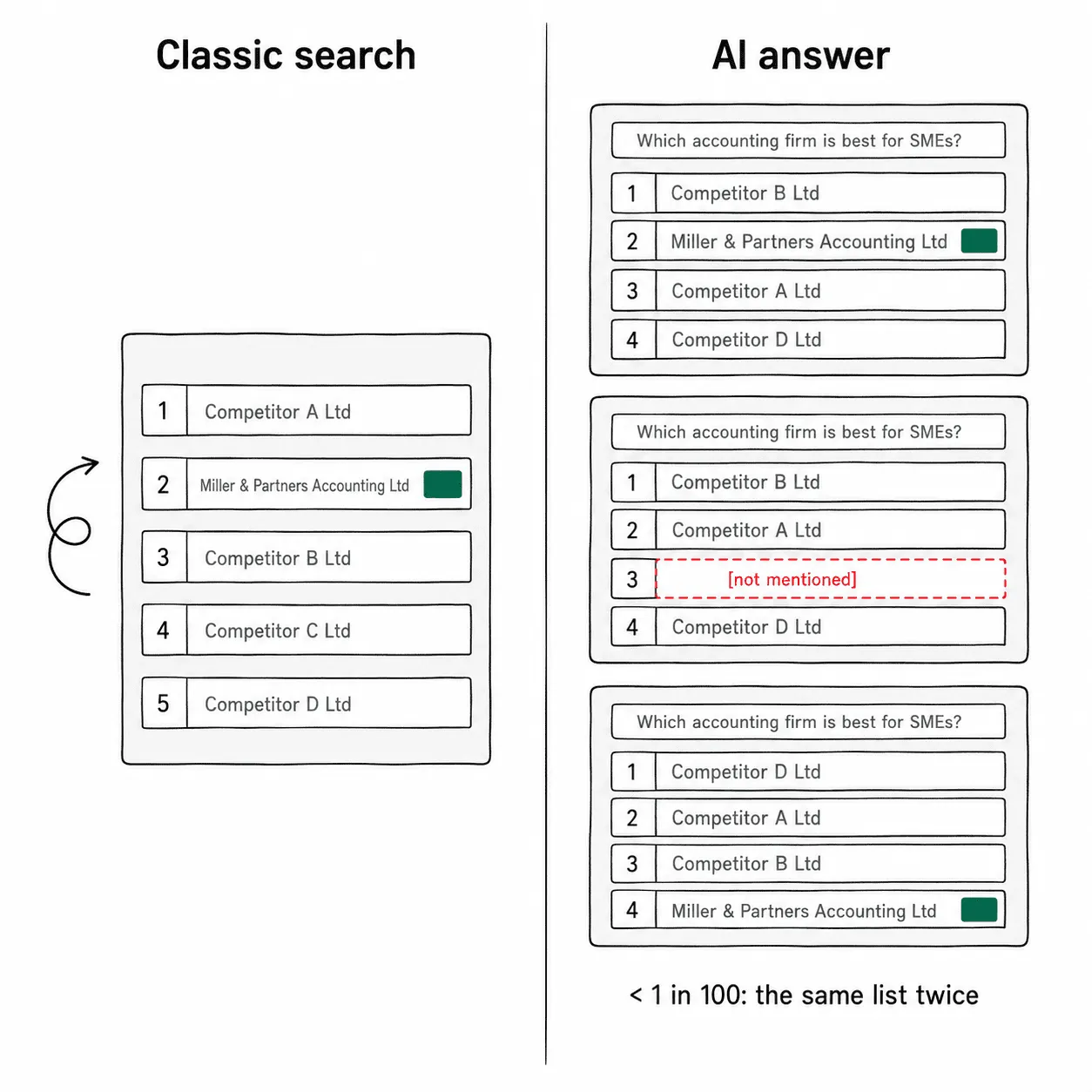
A position that changes with every measurement is not a position. That is why a different metric is needed.
Why is 100% visibility impossible?
100% visibility fails on two mechanisms: the narrow selection per answer, and personalization.
First, the selection. ChatGPT, Perplexity, and Google AI Overviews typically name three to five companies per answer. For any single answer the outcome is binary: you are in or you are out. There is nothing in between. Across many answers, that produces a rate, not a position.
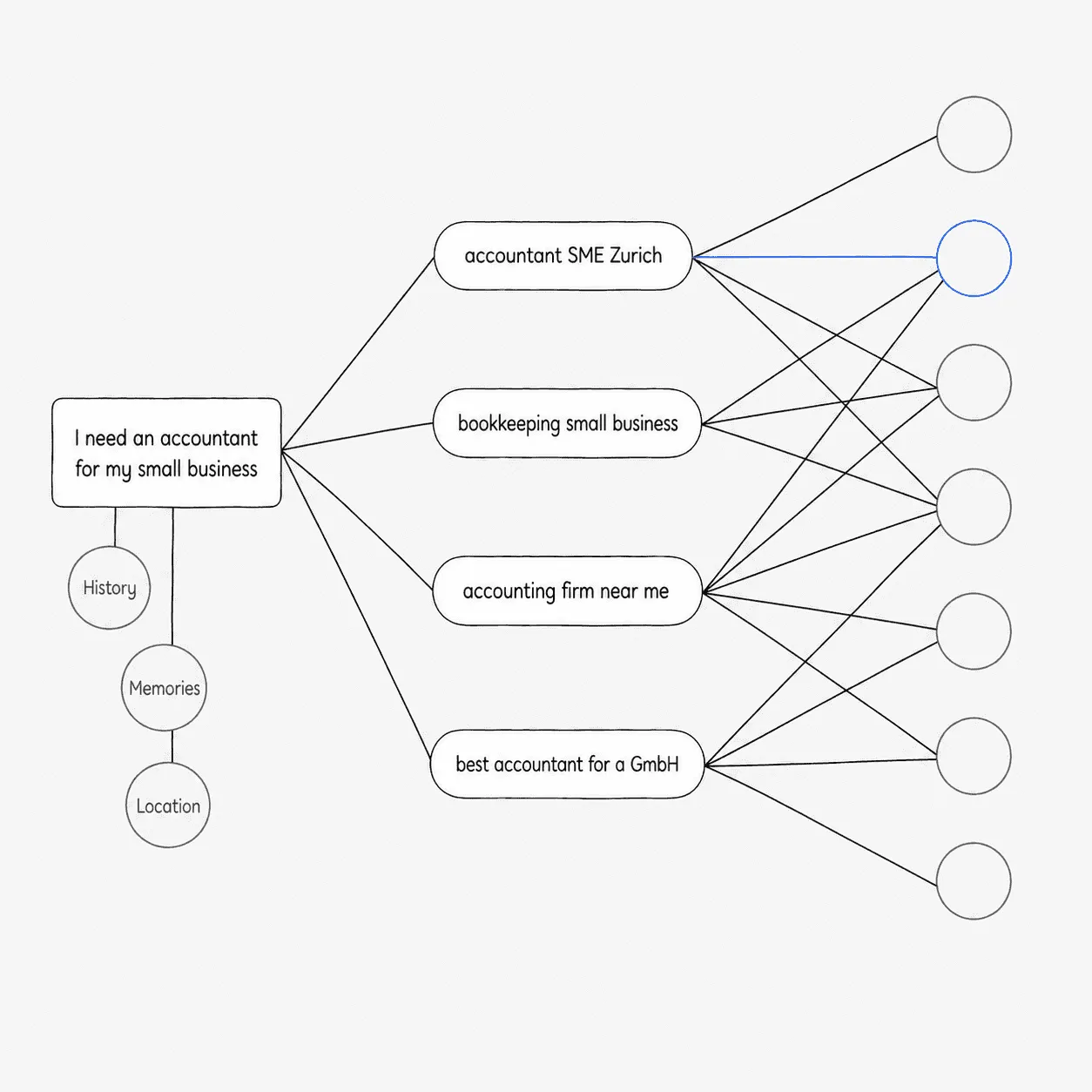
Second, personalization. Users usually type in something ordinary, for example “I need an accountant for my small business.” In the background the system enriches that question with conversation history, saved memories, and location, and starts several differently worded searches from it. This spreading out is called fan-out. Because the enrichment differs from person to person, not even the same account gets the same result twice.
Where the ceiling sits in practice is shown by the same SparkToro study: even global brands such as Bose, Sony, Sennheiser, and Apple appeared in only 55% to 77% of 994 answers to headphone questions. The highest single value reported there comes from a well-known US hospital: 69 of 71 answers, or 97%. Even in that extreme case, two answers carried no mention.
What is the recommendation rate, and how is it measured?
The recommendation rate is the share of repeated identical queries in which an AI system recommends your company as a provider. If a buyer question is asked 20 times and your company is recommended in 7 answers, the recommendation rate is 35%.
For that number to hold up, the measurement has to meet three conditions:
- The same questions over time. What gets measured is a fixed set of buyer questions, meaning questions potential clients actually ask. We work with around 50 of them per engagement, developed together during onboarding and refined as we go; an unsuitable question is corrected the way a wrong keyword is in SEO.
- Queried stateless. The measurement runs without a login and without memory, so the queries do not influence each other. Otherwise you are measuring your own history.
- Repeated and compared. 3 to 5 repeats per question, measured daily and compared weekly against the same defined competitors. More than roughly five repeats adds little accuracy. That is the implication of a variance analysis from July 2026, an arXiv preprint: not yet peer reviewed and written by an author with a commercial interest, but its core finding is derived mathematically, not merely observed.
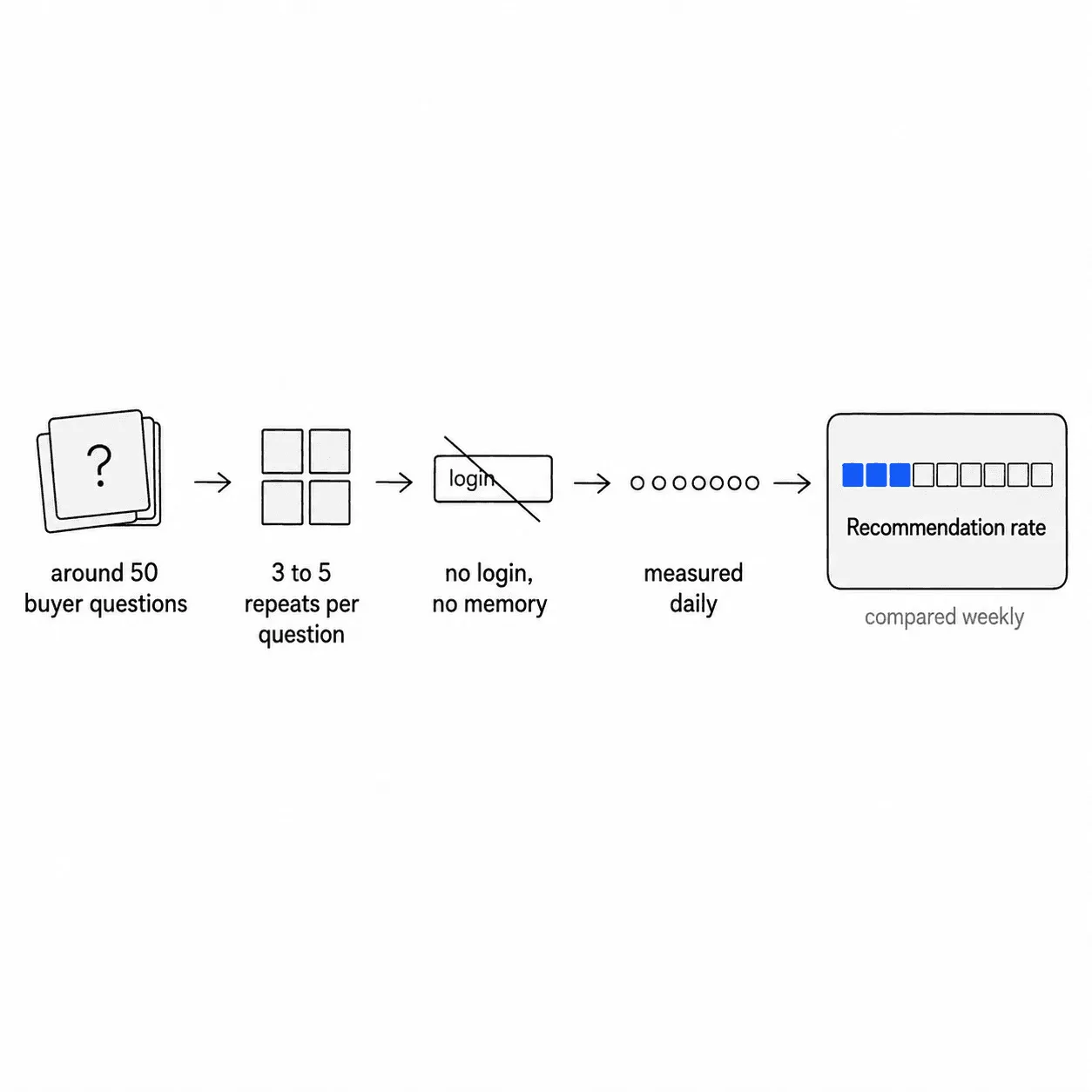
Out of this protocol comes first a baseline, then the weekly comparison: if the rate moves upward over weeks, the work is having an effect. A single query says as little about your visibility as a single roll says about whether a die is fair.
This shift from ranking thinking to a share metric is the core of GEO, the optimization for generative search systems: the measure of success is the share of AI answers your brand appears in. What GEO covers in detail is explained under What is GEO?
Mentioned or recommended: what is the difference?
Being mentioned in an AI answer and being recommended are two different events, and only the second one brings inquiries. A mention already exists when a system writes: “Alongside the large providers there are also smaller accounting firms.” A recommendation exists when the system answers the question “Which accountant would you recommend for a small business in Zurich?” by putting your company on the shortlist.
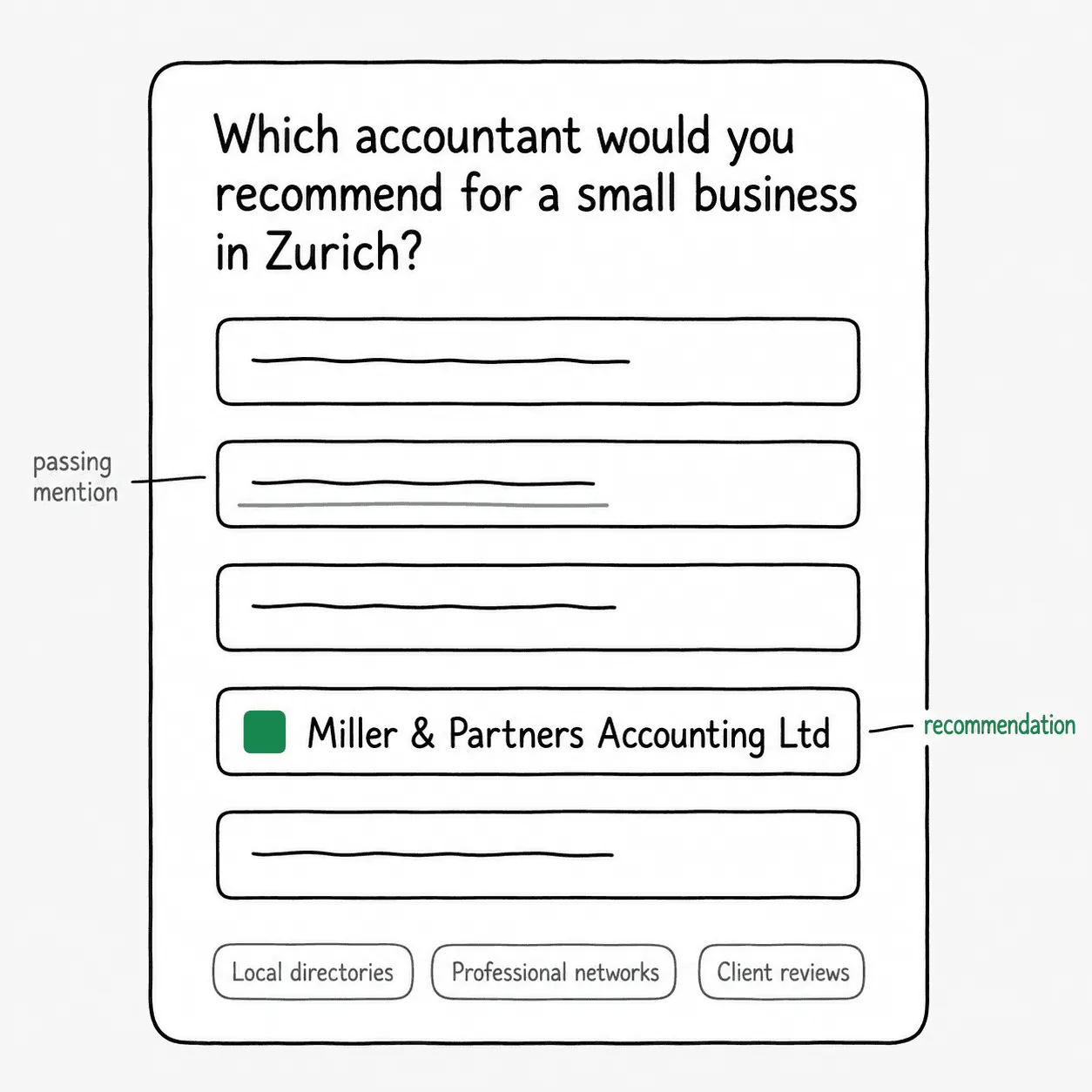
The market often fails to separate the two: many reports count plain mentions and present them as recommendations. An independent, binding definition of what counts as a “recommendation” does not exist so far. That makes it all the more important to know, for every number, which event was counted. When we at Carigiet GEO speak of the recommendation rate, we mean the second event: your company stands in the answer as a recommended provider.
Recommendation rate, share of voice, citation rate: what does each metric show?
Several metrics circulate in the market, and their definitions differ from vendor to vendor. The table sorts the most common ones:
| Metric | What it counts | What it does not show |
|---|---|---|
| Recommendation rate | The share of repeated identical queries in which your company is recommended as a provider | How prominently the recommendation sits inside the answer |
| Mention rate | The share of answers that name you at all, including in passing | Whether the mention is a recommendation |
| Share of voice | Your share of all brand mentions within a defined competitive set | How often you appear in absolute terms; the number depends on the set that was chosen |
| Citation rate | The share of answers that link your website as a source | Whether your brand is recommended in the answer text; being cited and being recommended often come apart |
| “Position” | The order within one single answer | Across repeats the order is not stable, which makes it useless as a metric |
Each of these rates is only as meaningful as its denominator. For every number, ask: a share of what, measured across how many queries?
What counts as a good recommendation rate?
For a Swiss SME in a competitive B2B field, 30% to 40% is a strong result. That is a reference point, not a promise: it follows from the mechanics that only three to five providers are named per answer, and that dozens of competitors usually compete for those slots. A company that is recommended in every third repeat of the same buyer question belongs firmly to the shortlist.
The corridor matches the field data: in the SparkToro study, the most visible providers in a broad B2B category (brand design agencies) reached values in the 30s and 40s. Two qualifications belong with that: the data is not Switzerland specific, and it comes from a field study, not from peer reviewed research. Independent Swiss benchmarks do not exist so far; we say that openly instead of inventing false precision.
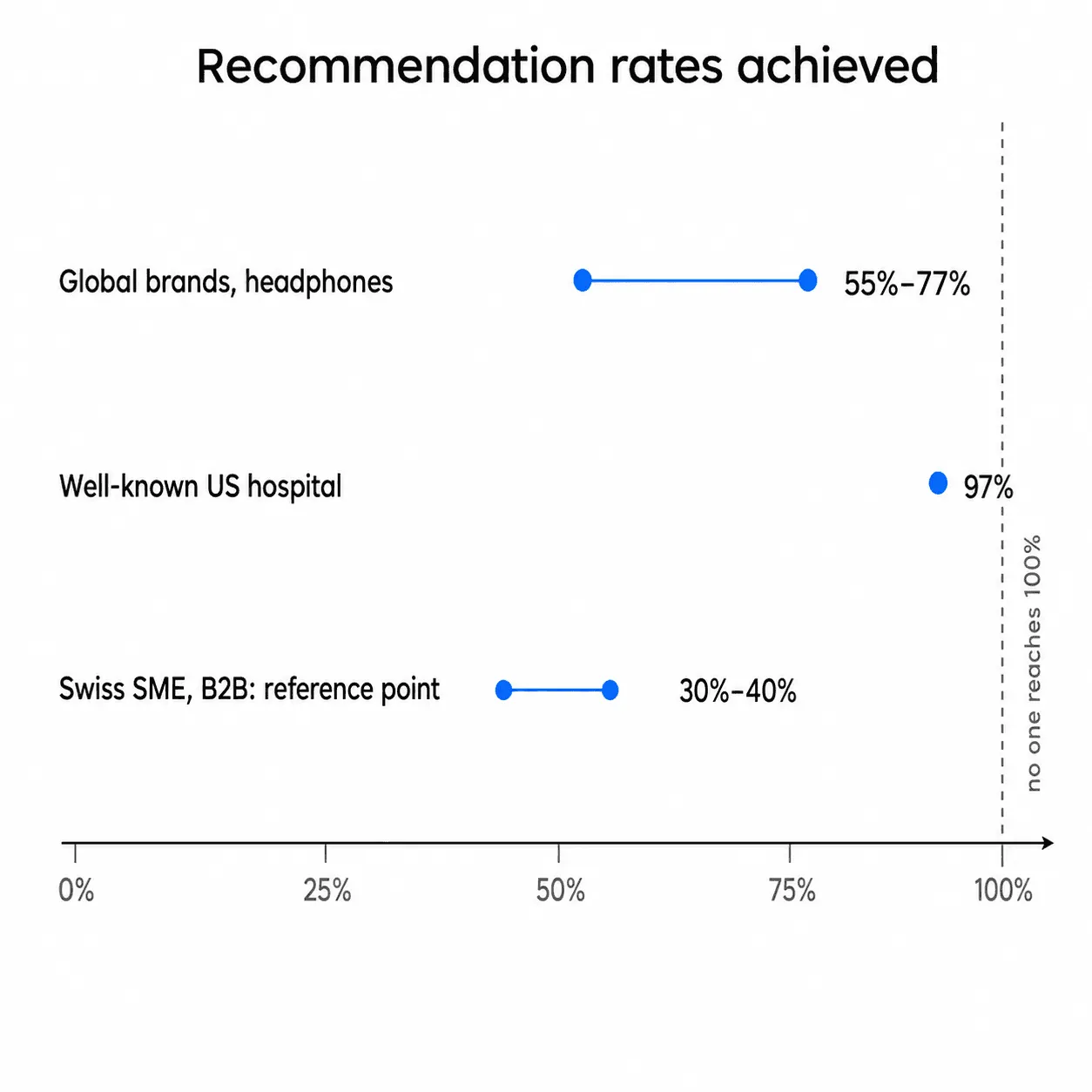
Considerably higher rates do occur, usually for brands with a source base built up over years. How long it takes before a rate moves at all is a separate question; the answer is in our article on how long it takes to appear in AI answers. And how the discipline behind it works as a whole is covered in our guide What is Generative Engine Optimization?
What should you do with a visibility number you already have?
Ask first how the number came about. A report with a single measurement per question is a snapshot of a system that answers differently on the next query. Six questions are enough to classify any visibility number:
- How many buyer questions were measured?
- How often was each question repeated?
- Did the measurement run without a login and without memory?
- Was it measured once, or over a period of time?
- Which competitors was it compared against?
- Does the number count recommendations or plain mentions?
If these questions stay unanswered, the number is not a measurement, it is an illustration. Two claims call for particular caution: a fixed position (“you are in position 2 in ChatGPT”) and a rate close to 100%. Neither is compatible with the documented scatter of these systems. In Switzerland, promising fixed placements would also be legally delicate: incorrect or misleading statements about your own services are unfair competition under Article 3(1)(b) of the Federal Act on Unfair Competition, quoted here in English translation, since Swiss federal law is authentic only in German, French, and Italian. There is, however, no precedent so far that deals specifically with guaranteed AI placements.
In our first conversations we therefore encounter the ranking question mainly as a question of trust: whoever asks it is checking whether a provider does honest math. The honest answer names the limits first and then shows what remains measurable.
Frequently asked questions about ChatGPT rankings
Does ChatGPT have rankings the way Google does?
No. Google has a results list that can be retrieved; ChatGPT generates every answer fresh and selects the providers it names statistically. What can be measured is how often your company is recommended across many repeated queries.
Why does ChatGPT give a different answer to the same question?
Because the answer is generated fresh and personalized on every request. Conversation history, saved memories, and location feed into it, and the system spreads the question into several differently worded searches in the background (fan-out). That is why two people, and often the same person twice, see different results.
Can a company reach 100% visibility in AI answers?
No. Even global brands reached only 55% to 77% in the SparkToro field study; the highest single value reported there was 97%, or 69 of 71 answers. Anyone reporting 100% to you has measured too rarely.
What recommendation rate is realistic for a Swiss SME?
As a reference point, 30% to 40% counts as a strong result in a competitive B2B field. The value follows from the mechanics of three to five providers named per answer, and it is not a promise.
Do AI visibility tools that report a ranking position work?
The rate such a tool reports can be useful; the position line cannot. A position is an artifact of one single answer, and the same query produces a different order the next time. Ask any tool how many repeats per question it runs, and whether it counts recommendations or plain mentions.
Is it worth asking ChatGPT yourself how visible your company is?
As a first impression, yes. As a measurement, no. Your own query is a sample of one, additionally colored by your history and your saved memories. A statement that holds up only emerges from repeated, neutral queries over time.
Measure your own starting point instead of trusting someone else’s number
There is no position in ChatGPT, but there is a measurable rate. Where your company stands today can be checked in a few minutes: the free AI Visibility Analysis shows you whether ChatGPT names you, which competitors appear instead, and which buyer questions you are missing from. The report arrives by email, usually within 15 to 30 minutes.
If you would like to discuss the results, we will check live in ChatGPT where you appear today, in a free 15-minute consultation. No sales pitch, no slides: you leave the conversation with two or three levers you can act on.
Related posts

Why Doesn't Your Company Show Up in ChatGPT? 9 Causes and What They Cost (2026)

llms.txt: Do You Need One? The Honest Answer (2026)