

Your firm appears in ChatGPT recommendations when the few sources AI systems assemble their answers from know your company and describe it correctly. Concretely, that means: service pages that state clearly what you do and where, identical company data everywhere down to the commercial register, maintained entries in directories, portals and association listings, plus independent third-party sources such as reviews and trade articles. And because individual AI answers fluctuate heavily, you need measurement that follows the trend over weeks instead of reading single queries.
One clarification up front: this guide is not about AI tools inside fiduciary work. It is about AI assistants naming and recommending your fiduciary firm when prospective clients ask them for a provider. In short: about winning engagements.
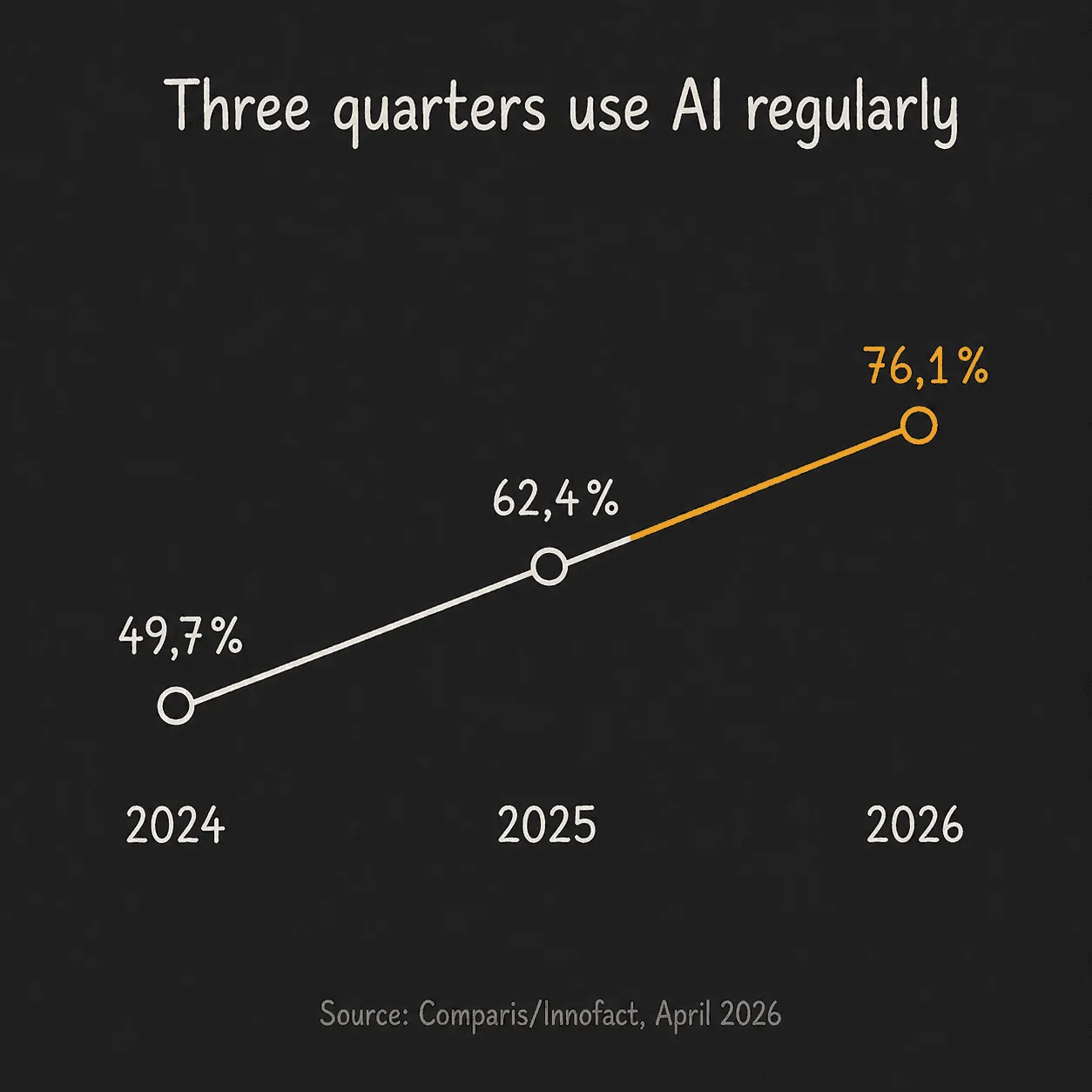
At Carigiet GEO, the fiduciary sector is one of our focus industries. We measure daily whether AI systems name Swiss SMEs in their answers, and we build the sources those answers are made of. The shift is documented: 76.1 percent of Swiss adults use AI tools such as ChatGPT, Gemini or Perplexity regularly in 2026, up from 62.4 percent the year before (Comparis/Innofact, March 2026). Anyone who asks there for a fiduciary does not receive a list of results, but a finished answer naming a handful of recommended firms. Whether yours is among them is decided by a few cited sources.
Key takeaways
- AI assistants answer provider questions with a few named firms instead of a list of links. The selection comes out of a small number of cited sources.
- For fiduciary questions, our July 2026 sample shows the systems citing above all lead-matching portals, directories such as local.ch, clearly structured firm service pages, and Google reviews.
- The most effective levers: precise service pages naming both service and location, identical company data everywhere, directory and association presence, independent third-party sources, and corrected false statements.
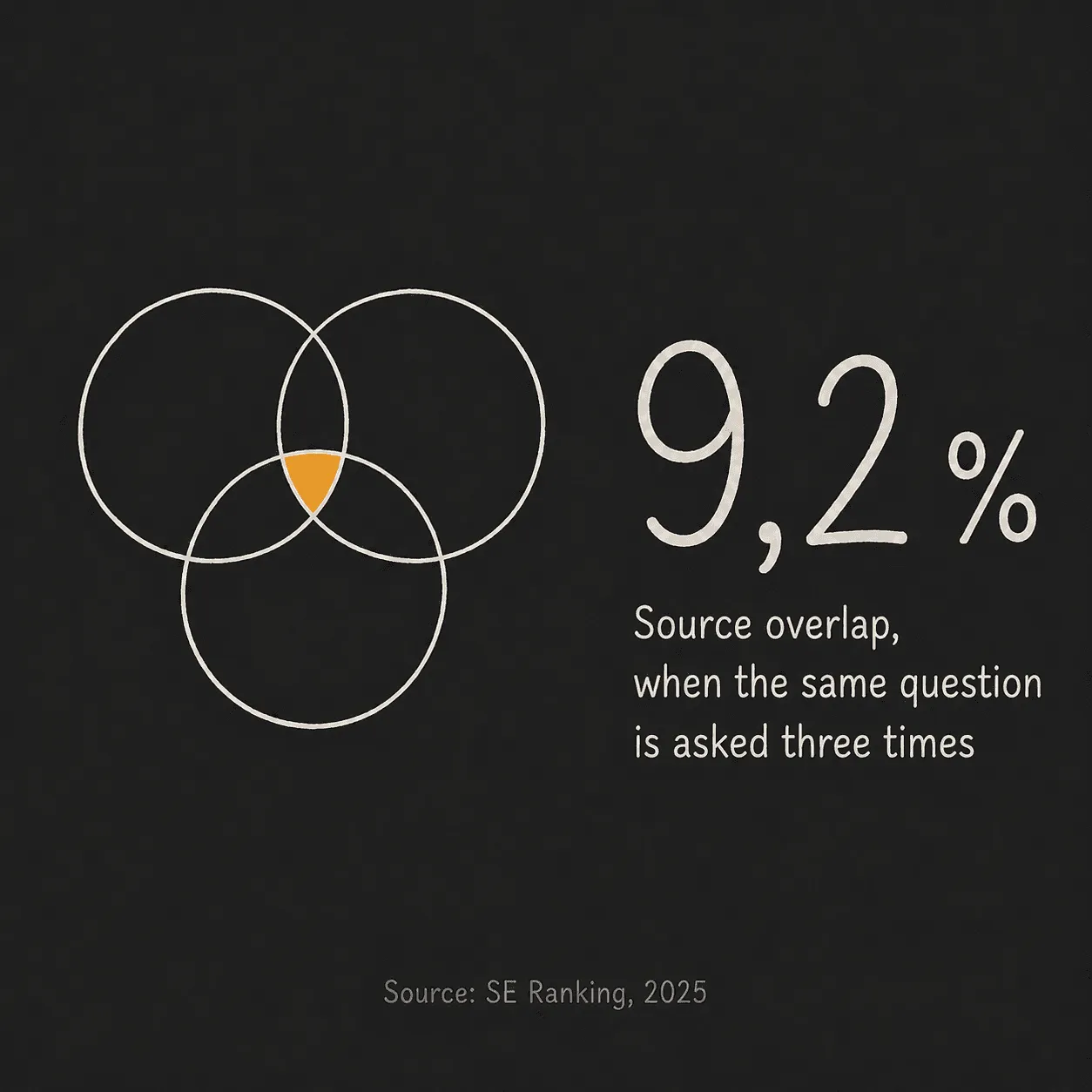
- Individual answers are volatile: repeat the same question three times and the cited sources overlap by only 9.2 percent. What holds up is the trend across weeks.
- Realistic time horizon: first measures in place by day 30, first reliable movement typically between day 60 and day 90, durable authority over 3 to 6 months.
- Nobody can credibly promise you fixed mentions. AI visibility can still be built measurably.
Why does your fiduciary firm not appear in ChatGPT answers?
The most common reason: the sources the answer is built from do not know your firm, or contain nothing concrete about it. AI systems do not invent their recommendations. They condense what directories, portals, reviews and your own website provide. If that trail is thin or contradictory, your firm is missing from the selection.
Then there is the size of the industry. Official statistics count 12,901 Swiss companies in auditing, tax advisory and bookkeeping (Federal Statistical Office structural business statistics, STATENT, 2022); the commercial register mirror business-monitor.ch currently lists as many as 16,400 active fiduciary firms. The difference comes down to counting method: the statistics record economically active units on a reference date, the commercial register every registered company with a fiduciary purpose. What matters for you is the consequence: an AI answer recommends a few providers out of that field. You are in or you are out. There is nothing in between.
Most firms start from a thin position. Corporate members of TREUHAND|SUISSE employ 6 people on average. A firm that lean rarely has capacity for directory entries, reviews and precise service pages. Yet those are exactly the traces the systems read.
At the same time, demand is shifting. Of those who know these tools, 41.6 percent already use them instead of a classic search engine, up from 27.2 percent in 2024 (Comparis). And AI has arrived in the daily work of corporate clients: the share of Swiss SMEs deliberately integrating AI into their work processes rose within a year from 22 to 34 percent (AXA SME Labour Market Study 2025). That figure measures AI use inside companies, not provider search. But it shows how routine the tools have become, including the ones your future clients use to look for a fiduciary partner.
How do AI assistants decide which fiduciary firms to recommend?
In three steps: the question is broken down into many search variants, sources are retrieved for each variant, and an answer naming a few providers is built from the best-supported sources.
The first step is called query fan-out, and it is the most underestimated. The user asks something plain: “Which fiduciary firm suits an SME with 20 employees in the canton of Aargau?” In the background, the system generates many search variants from this, adding location, service, phrasings such as “best”, or the year, and runs those searches in parallel. Google officially confirmed the technique at its I/O 2025 developer conference, and ChatGPT search works with a comparable retrieval layer (Search Engine Land). Whoever shows up in several of these variants is weighted more heavily in the answer: broad, consistent presence beats a single direct hit.
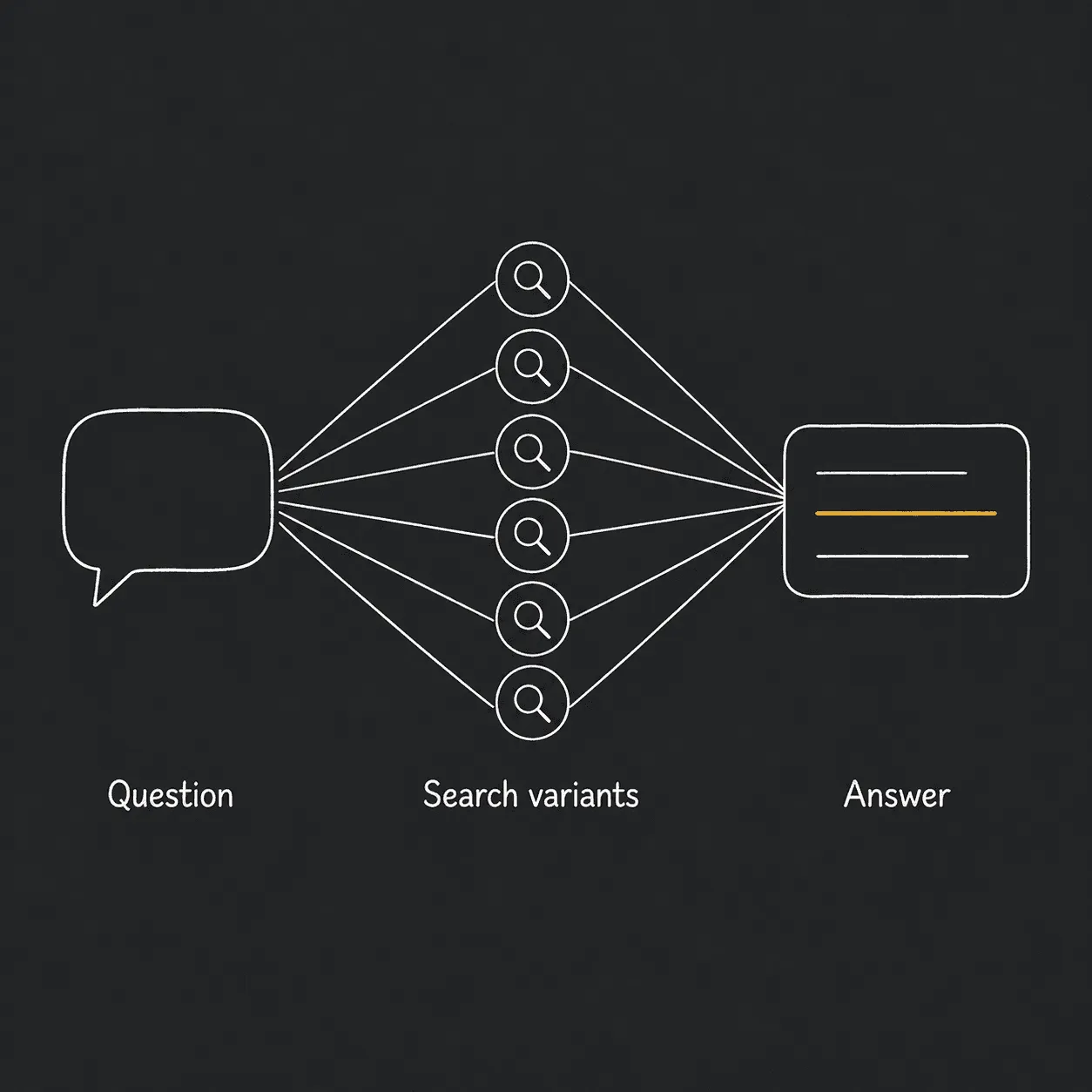
The second step is source selection. The Pew Research Center analysed 68,879 Google searches in the US: 88 percent of AI summaries cite three or more sources, only 1 percent rely on a single one (Pew Research Center, 2025). In direct recommendation answers, our observation is that this condenses to three to five highlighted providers. That is an experience value from measurement practice, not a hard figure.
One caveat belongs here: the answers are volatile. Repeat the same question three times and the cited sources overlap by only 9.2 percent (SE Ranking study across 10,000 keywords, via Search Engine Journal). A single query therefore proves little, neither your visibility nor your invisibility. What counts is frequency across many repetitions and weeks.
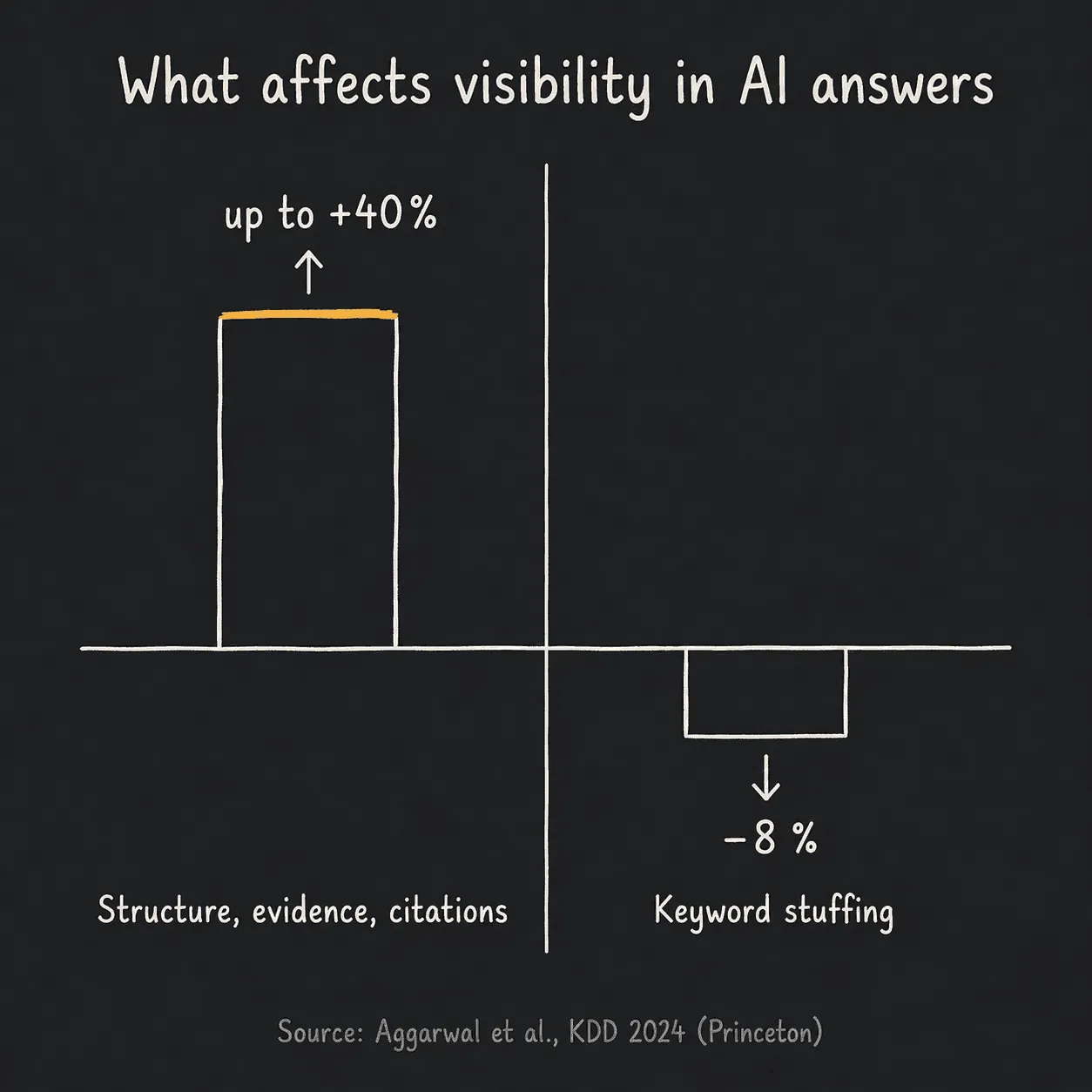
The selection can still be influenced. A Princeton University study shows that clear structure, supported statements and cited sources can raise visibility in generative answers by up to 40 percent, while classic keyword stuffing lands slightly below the starting position (Aggarwal et al., KDD 2024). Whoever understands how the systems produce answers can influence them: with clarity and evidence, not with tricks. At Carigiet GEO, that conviction comes out of 25 years in software engineering.
Which sources do AI systems cite for fiduciary questions?
Our July 2026 sample shows a clear pattern for German-speaking Swiss buyer questions: what gets cited is above all lead-matching portals, directories, clearly structured service pages of individual firms, and embedded Google reviews. We tested typical questions such as “Which fiduciary in Zurich would you recommend to an SME?” or “Looking for a fiduciary firm for payroll accounting and tax returns in Aargau”, at the retrieval layer AI assistants use for their answers. The result is a snapshot, not a constant.
Four source types dominated:
- Lead-matching and quote portals such as Gryps. They appeared most frequently and list many providers per enquiry.
- Directories such as local.ch with structured category and canton pages, for example “Treuhand Aargau”.
- Clearly structured service pages of individual fiduciary firms, following the pattern “Fiduciary services [city]: bookkeeping, payroll and taxes for SMEs”.
- Google reviews, embedded as a trust signal on firm websites.
Notable: the professionally authoritative member directories of TREUHAND|SUISSE or EXPERTsuisse rarely appeared at the top. The association entry still belongs on the list, but it replaces neither portal nor directory presence. The basic rule stands: whoever does not appear in these sources does not exist in the answer.
Here is how to classify the main source types:
| Source type | Examples | Degree of influence | Your first step |
|---|---|---|---|
| Your own website | Service pages with location and service | fully in your hands | one page per service, with location, target group and facts |
| Google Business Profile | Company profile with reviews | directly influenceable | update the details, ask for reviews factually |
| Directories | local.ch, search.ch | directly influenceable | claim the entry, sharpen services and categories |
| Lead-matching portals | Gryps and similar platforms | requires admission to the vetted network | apply for a company profile and maintain it fully |
| Association directories | TREUHAND|SUISSE, EXPERTsuisse, SwissAccounting | tied to membership | check the entry for completeness: specialisms, locations |
| Register data | Zefix, Moneyhouse | steerable only through correct facts | keep commercial register details current |
What exactly should you do? Five levers for your AI visibility
The order follows impact: first your own website and company data, then the external sources, and finally the corrections.
1. Build service pages that answer a question
A website saying “your reliable partner for fiduciary services” gives an AI system nothing to cite. What got cited in our sample were pages that answer a concrete buyer question: one page per service, with location, target group and facts. So “Payroll accounting for SMEs in Winterthur” instead of “Our services”.
Put the answer in the first sentences of the page: who you are, what you offer, for whom, where, with which team. Name your specialisms, the industries you focus on, and the size of the engagements you handle. Structure, concrete numbers, verifiable statements: exactly the elements the Princeton study mentioned above measured as effective.
2. Keep your company data identical everywhere
AI systems cross-check facts across several sources. Name, legal form, address, phone number and UID must match on your website, in the legal notice, in your Google Business Profile, in directories and in the commercial register. The reference is Zefix, the federal government’s public commercial register mirror; platforms such as Moneyhouse also draw on this commercial register data. After a move, a change of company name or a change of legal form, the rule is: update every entry in one pass. Contradictory details cost trust, with readers and with machines alike.
3. Occupy directories, portals and association listings
Your checklist follows from the source pattern above: Google Business Profile fully completed, entries on local.ch and search.ch claimed and sharpened, a maintained profile on lead-matching portals such as Gryps, plus the member directories of your associations: TREUHAND|SUISSE, EXPERTsuisse or SwissAccounting, formerly veb.ch. Enter the same specialisms and locations everywhere that your website also names. That way the sources confirm one another, and the systems weight that repetition across several search variants more heavily.
4. Create independent third-party sources
Self-description alone does not carry far: the systems check the overall picture across several independent sources. Google reviews from satisfied clients (asked for factually, without pressure), contributions in trade and regional media, an interview on a specialism such as succession planning or VAT: every independent source that connects your firm with a specialism and a location raises the probability that an AI system will adopt you as an evidenced recommendation.
An important point for fiduciary professionals: this is compatible with professional restraint. The industry’s code of conduct requires conscientious, objective professional practice, and AI visibility work in the sense described here is factual work: correct data, precise service descriptions, evidenced content. Promotional superlatives are not needed. They also do not help, as the keyword stuffing findings above show.
5. Find and correct false statements at the source
AI systems also pick up outdated and incorrect material: the former address, an abandoned specialism, confusion with similarly named firms. Comparis digital expert Jean-Claude Frick calls hallucinations a real risk that can quickly turn into a reputation problem in a corporate context (Comparis, media release April 2026). The effective route runs through the cause: find out which source the false statement comes from, and correct it there, in the directory, in the register, on your own website. So check regularly what AI systems claim about your firm, not only whether your name comes up.
How do you measure whether your firm is making progress in AI answers?
With a documented baseline and a weekly comparison of the same questions. Everything else stays anecdote.
The reason lies in the mechanics: the answers fluctuate (the 9.2 percent overlap mentioned above), and they are personalised. Location, history and stored memories change the result, even within the same account. Whoever asks once and sees a mention knows nothing yet. Whoever tracks the same question set over months sees a trend that holds up.
Measuring cleanly means:
- Query without login and without history, so the measurement does not influence itself.
- Repeat every question 3 to 5 times, to make the fluctuation visible.
- Set a realistic target: a recommendation rate of 30 to 40 percent across the repetitions is a strong result. Nobody reaches 100 percent.
- Keep the same question set, so that the weeks stay comparable.
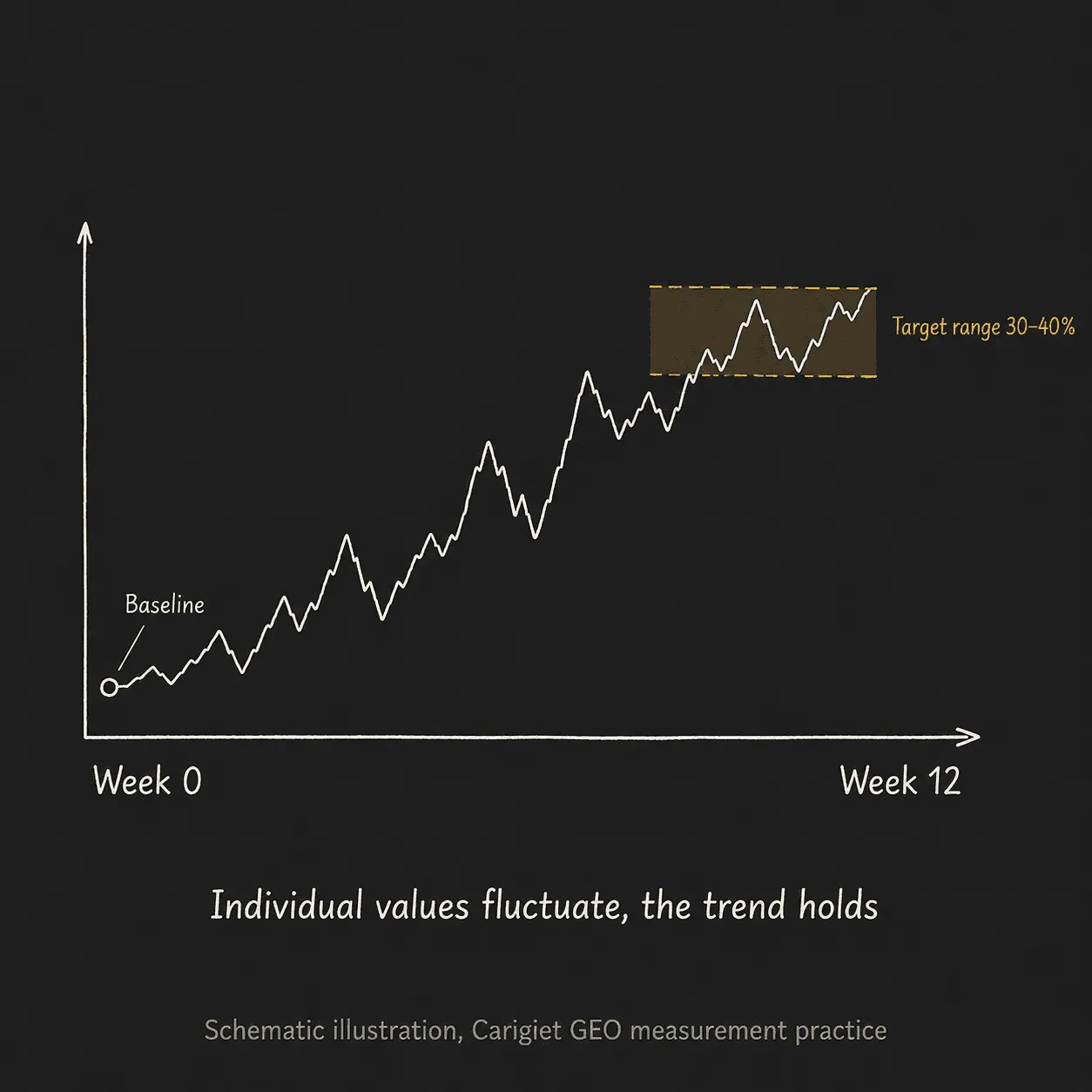
This is how we work at Carigiet GEO in every engagement: a structured onboarding produces a set of around 50 buyer questions. Within 7 days we document the baseline: which systems name your firm, which sources they cite, which statements are wrong. After that, the weekly comparison shows whether you appear more often, more accurately and better evidenced. The three levers behind it: source authority, answer integrity, and corrected factual statements.
If you want to take a first look at your own starting position: the free AI visibility analysis usually shows you within 15 to 30 minutes whether ChatGPT names your company, which competitors appear instead, and which statements are wrong or incomplete.
Frequently asked questions about AI visibility for fiduciary firms
How long does it take for a fiduciary firm to become visible in AI answers?
First measures are implemented by day 30, first reliable movement typically shows between day 60 and day 90, durable authority builds over 3 to 6 months. With a new brand or domain, count on 6 to 12 months or longer.
| Phase | Timeframe | What happens |
|---|---|---|
| Baseline | Week 1 | the baseline documents questions, systems, mentions, sources and false statements |
| First measures | by day 30 | quick levers: crawlability, clear answer passages, gaps on already cited sources |
| First movement | day 60 to 90 | first reliable change, still volatile, but recognisable as a trend |
| Authority | month 3 to 6 | consistent presence across several independent sources |
| New brand or domain | 6 to 12 months or longer | building the source base from the ground up |
If no signal at all shows by day 90, the cause is usually crawlability, unclear company details or third-party sources that are too weak, not a lack of patience. Why these timeframes look the way they do, and which factors accelerate or slow them, we have broken down in a separate article: How Long Until Your Company Appears in AI Answers?
What does it cost you to do nothing?
Enquiries you never get to see. Every AI answer without your firm in it is an enquiry another firm wins. On top of that comes the catch-up effect: the longer the same providers are cited, the more sources, mentions and corrections it takes later to get back into the selection. Being present early is cheaper than catching up late.
Is a good Google ranking no longer enough?
As a foundation yes, as a goal no. Google is rebuilding the entry point to search around AI answers itself: when an AI summary appears, only 8 percent of users still click a classic result, without a summary it is 15 percent (Pew Research Center, 2025). An honest assessment includes this: roughly 90 percent of the work on AI visibility is solid SEO. The difference lies in what is left. The work is done with whole buyer questions instead of individual keywords, every platform weights differently, and because the models change continuously, it takes ongoing re-verification rather than a one-off project.
Can anyone promise us fixed ChatGPT mentions?
No. Nobody can credibly promise you fixed mentions: the answers are volatile, personalised, and they change with every model generation. What is credible is what can be evidenced: documented measures, daily measurement, weekly comparison, and an open account of what has not moved yet. Stay sceptical, and demand proof of measurement from every provider, including us.
Where does your firm stand today?
The most sensible first step is a baseline assessment. In a 15-minute intro call we open ChatGPT live and check together whether your fiduciary firm comes up on the questions your clients actually ask, and which competitors are named instead. No sales pitch, no slides, and no preparation needed. You leave the call with two or three actionable levers. Whether you tackle them with us or on your own is your decision afterwards.
If you would rather see numbers first, start with the free AI visibility analysis. You receive the report by email. We work across Switzerland, remotely and on site.
Related posts

Why Doesn't Your Company Show Up in ChatGPT? 9 Causes and What They Cost (2026)

ChatGPT Ads for Swiss SMEs: What Applies and How to Run Them